

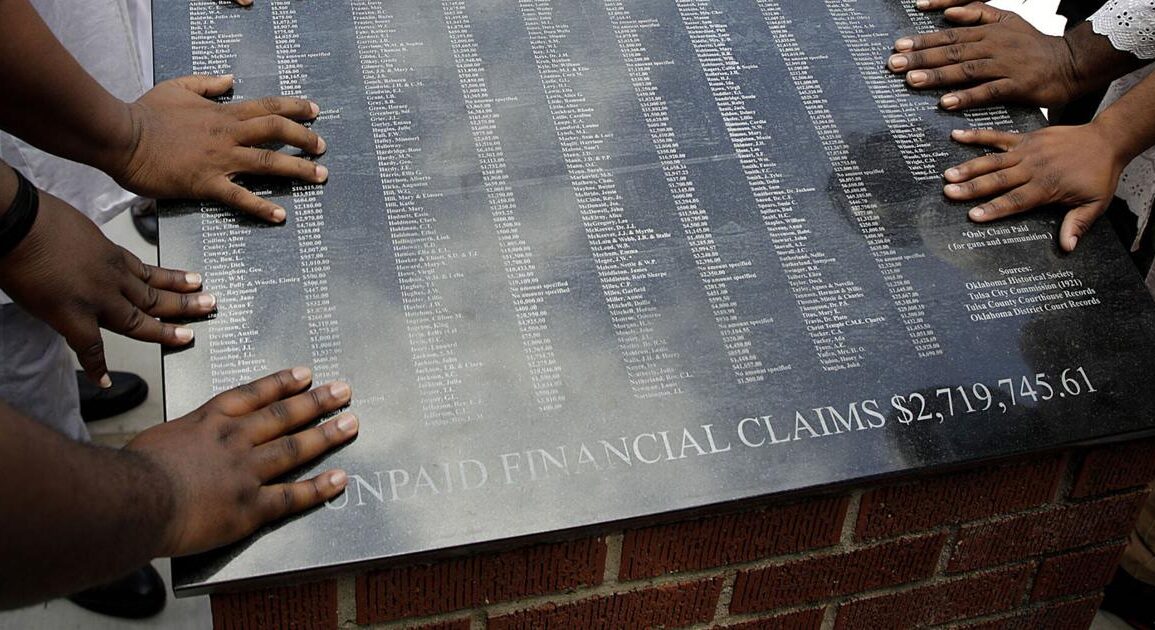

A commission established to identify ways the city can make tangible amends for the harm caused by the 1921 Tulsa Race Massacre is asking that nearly $25 million be provided to fund a Housing Reparations Program.
The Beyond Apology Commission’s recommendation, sent to former Mayor G.T. Bynum and current Mayor Monroe Nichols, asks the Mayor’s Office to work with the City Council to allocate $24.9 million that would be used to fund eight initiatives.
“The Housing Reparation Program seeks to provide some repair to the damage caused by racially motivated violence, inequitable policies (excluding perpetrators of the harm) in the 1921 Race Massacre as well as those left to rebuild in the aftermath,” commission members wrote in a memo to then-Mayor Bynum and city councilors dated Nov. 30.
The proposal calls for spending 82% of the funding on housing benefits for eligible individuals. That would include 32% of funding for a home/land ownership program; 30% of funding for a home preservation/improvement program; 12% of funding for a home ownership readiness program; and 8% for a mortgage and property tax assistance initiative.
People are also reading…
The remaining dollars would be used to purchase property for north Tulsa development, establish a $2 million reserve trust to pay for future benefit programs, and to cover administrative and management costs.
The commission also recommends that the city allocate annually a portion of the its budget surplus and/or general fund to pay for ongoing reparations programs.
Commission Chairwoman Kristi Williams said the community should be proud of the recommendations put forth by the commission.
“This was their work,” Williams said. “From the beginning of Beyond Apology, all of the commissioners truly lead and make decisions based on what the community said that they wanted. And so we hold that in the forefront all the time as we’re discussing and making decisions.”
Williams emphasized a point made in the BAC’s recommendation — that the $24.9 million is only an initial request for funding.
“Definitely, we will be working on the other themes. Housing is just one of those, but we will, and actually we started to prioritize which ones we’re going to be working on next,” Williams said. “So we will be working on that and are committed to doing so.”
To apply for benefits, individuals would have to be at least 18 years old, be of Black/African American ancestry, and fall into one of four tiers by which applications would be accepted and reviewed and benefits awarded.
Survivors — excluding perpetrators of the harm — would make up the top tier, followed by descendants, defenders and rebuilders, residents of Greenwood/north Tulsa from 1926 to 1971, and residents of Greenwood/north Tulsa from 1972 to 2020.
The Mayor’s Office, in conjunction with the Beyond Apology Commission, would be responsible for overseeing the Housing Reparations Program. The commission would determine who qualifies for benefits based on the criteria set out in the proposal.
Bynum established the Beyond Apology Commission by executive order in July 2024 after the creation of such a body was recommended in the Beyond Apology report.
That document summarized the results of the Beyond Apology process, a series of community-led public meetings to engage and educate Tulsans about reparations and repair programs.
Attendees were asked to identify priorities they would like to see the city focus on as it attempts to address the harm caused by the Race Massacre.
The Beyond Apology report listed eight priorities for possible repair and reparations: housing and home ownership, education, financial compensation, community and economic development, land, health and wellness, system change, and cultural identity.
Neither Bynum nor Nichols has committed the city to paying reparations in the form of direct payments, but both have been open to establishing policies and programs to benefit those harmed during the Race Massacre, their descendants, and individuals who were affected by later discriminatory practices and policies of the city.
At the Beyond Apology Commission’s inaugural meeting in October, Bynum said housing equity had been chosen as the first priority to address because the city has a housing shortage and Tulsans approved $75 million for housing in the 2023 Improve Our Tulsa capital improvements package.
Greg Robinson, who facilitated the Beyond Apology process, said the $24.9 million figure was based on best practices established in cities like Evanston, Illinois, that have implemented reparations programs.
“It certainly is not a number that is out of thin air,” Robinson said. “It’s a number that to us is rooted in a fair percentage of investment based on what we know … for sure, is available.”
“When you look at Evanston and a city of that size, and the harms that they identified, they started with the number that was $10 million, and so when you do the comparisons in terms of Tulsa versus an Evanston, this number is one that falls in line with national best practices of where to start.”
It is not clear whether or how Nichols plans to move forward with the commission’s request. In a statement issued Friday, he welcomed the commission’s work and indicated he would speak to the matter soon.
“As mayor, I am grateful for the dedication and work of the Beyond Apology Commission,” Nichols said. “The commissioners took on the nearly impossible task of aligning around a plan to appropriately address the harm caused by the 1921 Tulsa Race Massacre.
“I look forward to reviewing their recommendations and, in the coming weeks, share a framework that will serve as proof that Tulsa is united in healing the wounds left by the Massacre nearly 104 years ago.”
The Beyond Apology Commission’s recommendations come nearly four years after the city commemorated the centennial of the Race Massacre.
The violence of May 31-June 1, 1921, left at least 37 people dead — a figure many believe to be much higher — and destroyed 35 blocks of the historic Greenwood District.
Greenwood was home to what was known as Black Wall Street, one of the most vibrant and prosperous Black communities in the country at the time.
One hundred years later, in June 2021, the City Council and Bynum signed a nonbinding resolution acknowledging and apologizing for the Race Massacre.
The resolution also included a commitment to make “tangible amends” for the tragedy and a pledge to establish a community-led effort to recommend ways the city could make “significant progress toward restoring economic mobility, prosperity and generational wealth for the 1921 Race Massacre survivors, their descendants, and residents of North Tulsa.”
The Beyond Apology Commission’s recommendations are the manifestation of that pledge.
The Tulsa World is where your story lives.
The Tulsa World newsroom is committed to covering this community with curiosity, tenacity and depth. Our passion for telling the story of Tulsa remains unwavering. Because your story is our story. Thank you to our subscribers who support local journalism. Join them with limited-time offers at tulsaworld.com/story.
