

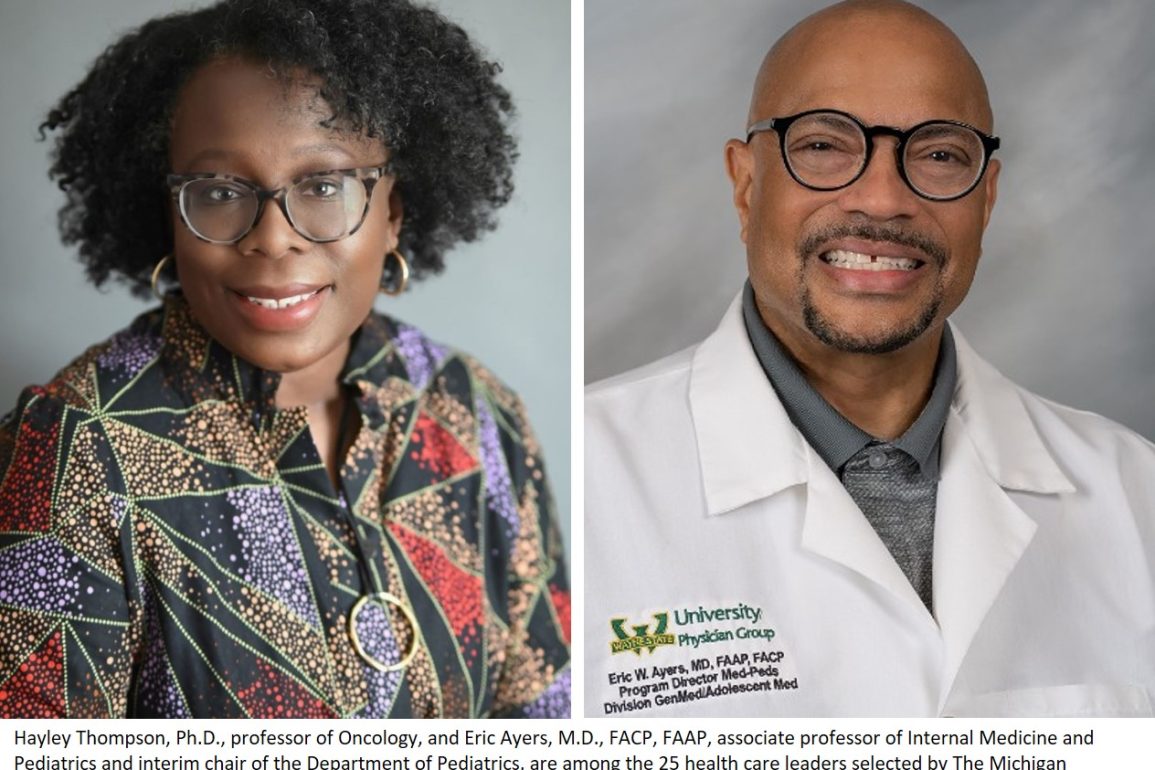
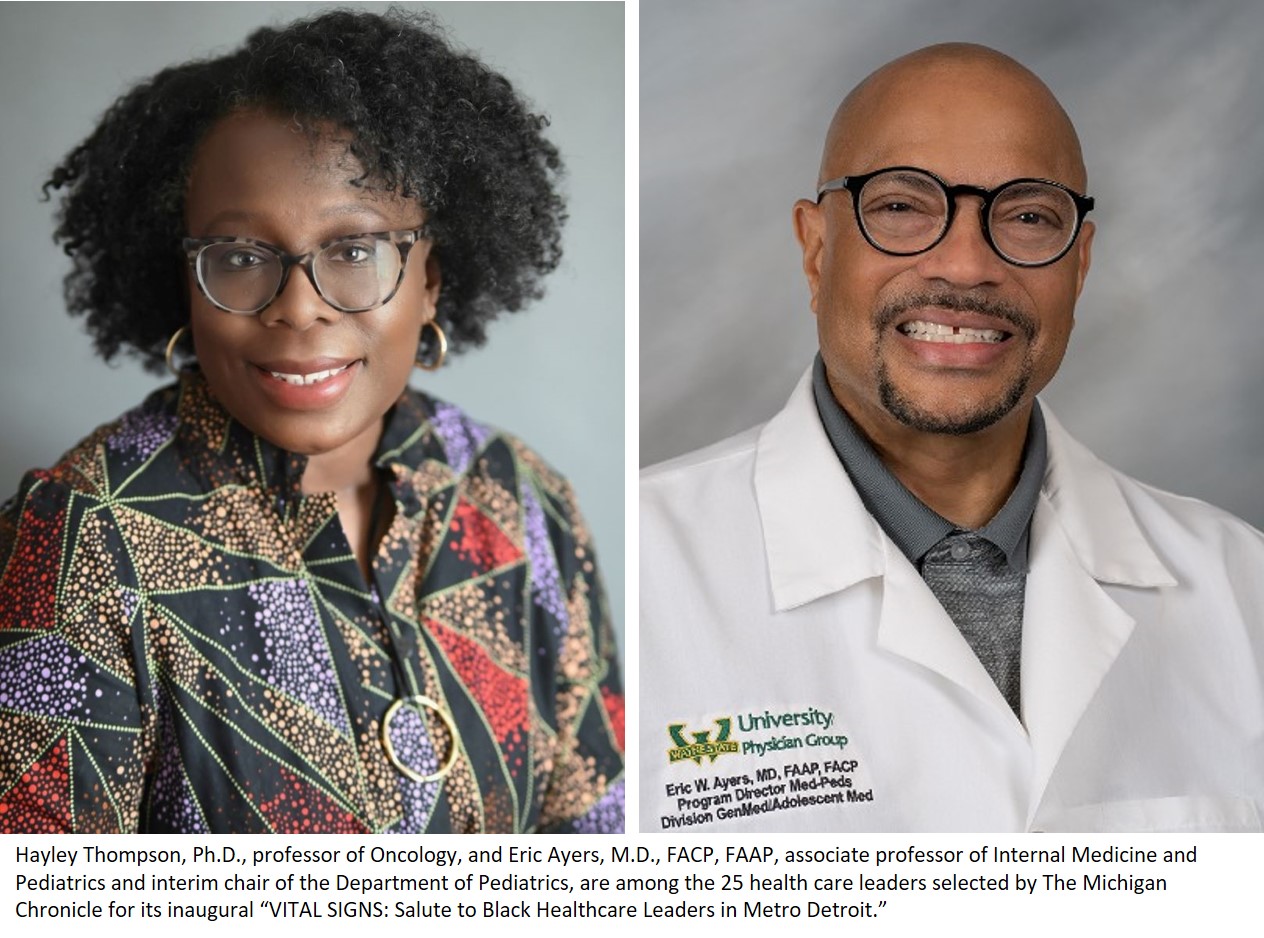
Two members of the Wayne State University School of Medicine have been recognized as Black health care leaders in metropolitan Detroit.
Hayley Thompson, Ph.D., professor of Oncology, and Eric Ayers, M.D., FACP, FAAP, associate professor of Internal Medicine and Pediatrics and interim chair of the Department of Pediatrics, are among the 25 health care leaders selected by The Michigan Chronicle for its inaugural “VITAL SIGNS: Salute to Black Healthcare Leaders in Metro Detroit,” published Oct. 25.
“The strength of a community is reflected in the health of its people—and in the commitment of those who work to ensure that quality care is within everyone’s reach. With Vital Signs, we proudly recognize 25 leaders whose contributions advance excellence, accessibility and equity in health care across our region,” wrote Hiram Jackson, publisher of The Michigan Chronicle and chief executive officer of Real Times Media. “These individuals bring different experiences, responsibilities and perspectives to their work. Their contributions span patient care, research, organizational leadership, workforce advocacy and community service. What connects them is a steadfast commitment to improving lives and addressing the barriers that too often prevent individuals and families from receiving the care they need. For African American and other underserved communities, that commitment carries particular significance. Access involves more than the availability of an appointment. It also requires trust, understanding, respect and care that responds to the realities of people’s lives. The leaders celebrated in these pages are helping move that promise forward.”
Dr. Thompson is the director of the Wayne State University Community-Engaged Collaborative for the Promotion to Access of Technology and Health, which works to improve the health of the region through meaningful community-academic collaborations and community-engaged solutions and research. The program represents an expansion through an emphasis on the digital divide and digital health equity, the fair and just opportunity for all individuals and communities to engage with digital health tools, and resources to support positive health outcomes. CEC-PATH builds on a history of fostering coalitions, including the Detroit Community Health Alliance & Partnerships, a multi-sector coalition formed in 2023 committed to implementing multilevel community-based health interventions to improve cardiovascular health, cancer control and mental health. D-CHAP has 40 members, including 24 community-based organization representatives and residents, who collaborate to bring about community-level changes that foster health-promoting opportunities and behaviors.
D-CHAP recently established a Research Workgroup, a new advisory body serving as an active connector between academic researchers and community stakeholders seeking to establish meaningful research partnerships.
“This honor is deeply humbling and made even more meaningful because it celebrates the excellence and impact of Black health care leaders,” said Dr. Thompson, who also serves as associate center director of Community Outreach and Education, and faculty supervisor of the Office of Community Outreach and Engagement at the Barbara Ann Karmanos Cancer Institute. “Since moving to Michigan 15 years ago, I’ve had the privilege of working with talented and dedicated colleagues and community stakeholders to improve cancer prevention, screening and survivorship throughout the state. More recently, our teams have cultivated robust coalitions to advance health equity beyond cancer. All of these efforts are connected to research that tries to engage community members as not only collaborators in science but leaders and decision makers. This recognition from The Michigan Chronicle affirms that all of this work matters. I’m very grateful to have been nominated and selected, and I share this honor with every patient, community partner and co-worker who has walked this journey with me. I especially want to acknowledge my staff over the years who have made so much possible.”
The COE coordinates many initiatives within the 46 counties it serves across the state. These include training community members to educate networks about cancer prevention and screening, teaching community members about the basics of research, convening community members to identify cancer research priorities and building ongoing relationships between the community and researchers.
Dr. Thompson in the principal investigator of a 2026 American Cancer Society Cancer Health Research Center grant to WSU and Karmanos that established the Digital Engagement and Cancer Outcomes Center. The center’s goals are to better understand the impact of the digital environment and digital inclusion on outcomes and disparities among Black cancer patients, survivors and caregivers, and advance interventions that both integrate and impact hospital and community resources to improve outcomes at the individual level. Funded by the four-year, $4.07 million grant, researchers will build and strengthen connections with Detroit’s digital equity ecosystem; link cancer patients, survivors and caregivers disadvantaged by the digital divide with a range of resources that promote digital inclusion; and, ultimately, improve cancer care and outcomes.
The Chronicle wrote that Dr. Thompson’s “leadership makes community knowledge part of how a cancer center works. In 2016, she established Michigan Cancer HealthLink, a partnership now encompassing eight Cancer Action Councils. Survivors, caregivers and advocates help inform research and programming, bringing perspectives from Black men, young survivors, rural residents and other communities. In Detroit, that commitment takes practical form through the Witness Project of Detroit and its successor, Real Talk: Breast Cancer. The Witness Project reached 2,043 people, predominantly Black women. Real Talk and related programming have reached approximately 1,500 people since 2019. Participants are assessed for screening eligibility and offered help navigating care.
The newspaper also noted that in 2025 her team launched the Connection to Care Community Grant Program, providing four organizations between $20,000 and $30,000 each. During a six-month pilot program, three partners identified 303 people eligible for breast cancer screening and 162 eligible for lung cancer screening, offering navigation assistance. It also recognized Dr. Thompson’s partnership with the Inter-Tribal Council of Michigan, a statewide organization, to support the Little Traverse Bay Bands of Odawa Indians Health Clinic.
The Chronicle called Dr. Ayers “Dr. 313,” for his dedication to his young patients in the now famous Detroit area code.
“Dr. Eric Ayers combines hometown knowledge with organizational leadership to strengthen pediatric care for families facing barriers to access. For Dr. 313, caring for Detroit’s children is personal. The nickname carries more than Detroit’s area code. For Dr. Ayers, born and raised in the city, it reflects a connection to the families he serves—and an understanding of the challenges that can stand between a child and consistent health care.
Wayne Pediatrics, of which Dr. Ayers is president, serves children and adolescents throughout Detroit and Wayne County, including many covered by Medicaid. Its patients, the Chronicle noted, include children in foster care, those managing complex medical conditions and families navigating food insecurity, unstable housing or unreliable transportation.
“Ayers has championed care that connects medical treatment with behavioral health and social support. Physicians, nurses, social workers and care managers work together to address needs that rarely fit neatly into a single appointment. Outreach through mobile health services and partnerships with schools and community organizations extends that approach beyond clinical settings,” the newspaper wrote.
He has overseen organizational restructuring to more effectively align resources with maintaining patient care, and developed relationships with philanthropic and community funding partners to sustain and expand services for underserved families. “His emphasis on accountability reaches into the patient experience,” the newspaper wrote. “The organization monitors well-child visits, immunizations, asthma management and developmental screenings alongside appointment availability and family feedback. These measures help identify gaps in care and guide improvements; screening for social needs helps teams understand the obstacles families face.”
“Detroit raised me, and caring for its children is how I give back,” Dr. Ayers said. “The families we serve face real barriers, like housing, food and transportation, and good care has to meet them where they are. I’m proud to be called ‘Dr. 313,’ but that name belongs to every doctor delivering care in this city. Through my work and my actions, I aim to represent all of us who show up for Detroit’s children every day.”
Dr. Ayers, a 1989 graduate of the WSU School of Medicine, possesses a combination of pediatric expertise, proven leadership and deep commitment to Detroit’s children. He is widely recognized for his contributions to mentoring, diversity and innovative medical education at the school. He joined the WSU faculty in 1993. He is the associate program director of the Med-Peds Program in the Department of Internal Medicine, and director of Mentoring, Engagement and Coaching in the Office of Student Affairs and Undergraduate Medical Education. From 1994 to 2022, he served as the Med-Peds Program director.
On the staff of Children’s Hospital of Michigan, Detroit Receiving Hospital, Hutzel Hospital and the DMC Rehabilitation Institute of Michigan, Dr. Ayers is a member of the Gold Humanism Honor Society, Alpha Omega Alpha, the Society of General Internal Medicine/American College of Physicians, the Association of Program Directors in Pediatrics, the American Academy of Pediatrics, the National Medical Association, the Detroit Medical Society and the Medicine and Pediatrics Program Association.
He has developed innovative pediatric curricula, including specialized tracks in adolescent medicine and transitional care, and created pediatric elective rotations that have enhanced medical student education.
Dr. Ayers is the recipient of numerous awards, including the 2024 Jerry Yee Mentorship Award from the Michigan Chapter of the American College of Physicians, presented to Internal Medicine physicians with a “demonstrated commitment to supporting the scholarly and professional advancement of their students, trainees and junior colleagues” who demonstrate “consistent and high-quality mentoring in clinical research, post-graduate scholarship or professional development.” He also received the Leadership in Med-Peds Award from the Alliance for Academic Internal Medicine. In recent years, he was honored as the Internal Medicine and Pediatrics Residents’ Teacher of the Year and received multiple recognitions for humanism, compassion and advocacy in medicine. Nationally, he has held leadership positions with the National Med-Peds Program Directors Association and the Student National Medical Association and locally has served on advisory boards for schools and community organizations dedicated to youth development and health equity.

A longtime devoted mentor of medical students and an advisor to the WSU chapter of the Black Medical Association/Student National Medical Association, he has been recognized with an Outstanding Teacher Award from the School of Medicine. He has received numerous national and local recognitions for his commitment to teaching, humanism and community service, including the Pfizer Humanism in Medicine Award in 2004 and the Alfred Tow Award for Humanism in Medicine in 2006. The Wayne State University School of Medicine Alumni Association honored him with its Alumni of the Year Award in 2019.