

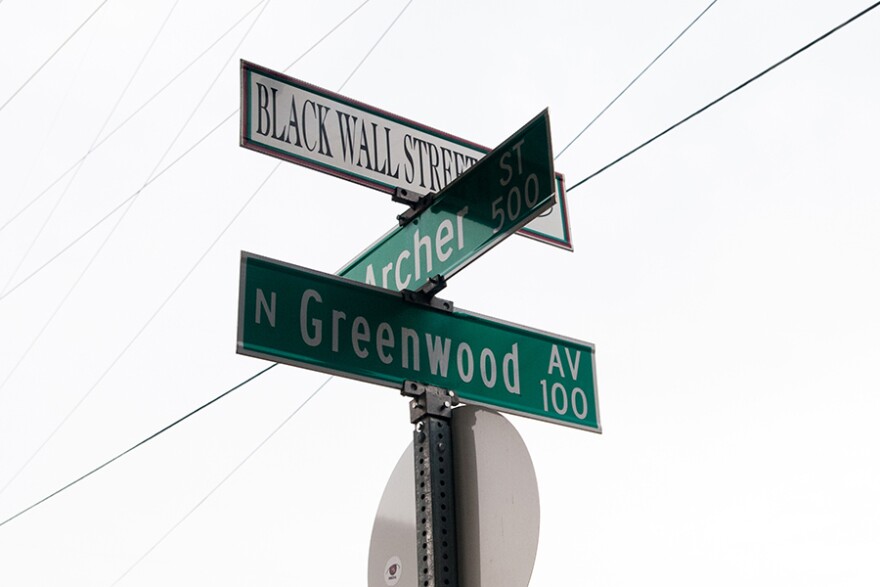
A sweeping plan to restore Tulsa’s Greenwood district, destroyed during the 1921 Tulsa Race Massacre, was announced Tuesday by the nonprofit advocating for its last living victims.
Project Greenwood, unveiled by lead lawyer Damario Solomon-Simmons, is the group’s latest effort to bring justice to survivors of the massacre and their descendants after the Oklahoma Supreme Court dismissed a reparations lawsuit in June 2024.
Solomon-Simmons said he and his team were already working on the newly announced project before the state court officially shot down the case.
“This will promote true healing and reconciliation for our city. It will remove the dark cloud that sits on top of Tulsa,” he said.
The Greenwood Project restates some of the previous lawsuit’s objectives, including a victim compensation fund for the massacre’s descendants and its two lasting survivors – Lessie Benningfield Randle and Viola Ford Fletcher, who are both 110 years old.
“They both want to see justice before they die,” LaDonna Penny said through tears during the press conference announcing the project. She is one of Randle’s granddaughters.
“If this is the opportunity to give them their flowers while they’re still here, then the city needs to do it,” Penny said. “We need to step up.”
A week before the conference on Tuesday, the Department of Justice released a report qualifying the Tulsa Race Massacre as a “coordinated, military-style attack.” Still, it concluded no person alive could be prosecuted.
The massacre is considered to be one of the worst episodes of racial violence in American history because of its scale and the toll it had on the local community. On May 31 and June 1, 1921, a white mob burned the Greenwood neighborhood to the ground, killing as many as 300 people. Thirty-five blocks were left smoldering, and the north Tulsa town lost the successful restaurants, hotels, grocery stores and theatres that gave its name as Black Wall Street.

Jamie Glisson
/
Focus: Black Oklahoma
Though the project is in the early stages, Solomon-Simmons said he was exploring private-public partnerships to help to finance it. He also said the project is not race-based and that the funds and support it establishes are not limited to Black victims.
“It’s harm-based and that’s very, very important,” he said.
The project also proposes bringing a trauma hospital and urgent care center to the neighborhood to address longstanding health disparities caused by the destruction.
It asks the city to conduct an audit of the land it owns in Greenwood to determine whether it was unlawfully secured during or after the massacre. Identified properties are to be returned to the original owners’ families or the city should pay them market value, according to the project.
Tulsa Mayor Monroe Nichols indicated support for “significant elements” of the project but has not clarified which parts he is in favor of.
“Project Greenwood reflects the unshakable resolve of the last living massacre survivors and descendants to address the generational impact of Greenwood’s destruction and move Tulsa forward,” Nichols said in a written statement.
Nichols said he will address the plan in full in the coming weeks.
The full project plan includes the following components:
- Direct payments to the last known living Tulsa Race Massacre Survivors, Viola Fletcher and Lessie Randle.
- A business program and contracting preference program helping descendants seeking employment.
- A scholarship program available to verified descendants who are residents of Oklahoma and those in other states who seek to attend a university, college, or other post-high school program in Tulsa.
- A surviving entity program that supports growth of entities like churches or businesses still left standing after the massacre.
- Immunity from all City of Tulsa taxes, fees, assessments and/or utility expenses for massacre survivors and descendants.
- A land audit requiring the city to determine whether the land it owns in Greenwood was unlawfully gained during or after the massacre, and return identified land to the original owners or pay the families market price for the land.
- A new level 1 trauma center in north Tulsa named after Dr. A.C. Jackson, a Black surgeon killed during the massacre.
- An official holiday on June 1 an official holiday to ensure the Tulsa Race Massacre is never forgotten.
- Release all Tulsa Race Massacre records.
- Open a criminal investigation at Oaklawn Cemetery for victims killed in the massacre.
Karlos Hill said he thinks of Tulsa as a microcosm of America’s relationship with racial violence. Hill is the chair of the Clara Luper Department of African and African American Studies at the University of Oklahoma. He’s also the author of The 1921 Tulsa Race Massacre which chronicles the massacre’s trauma through photographs.
“This is a litmus test for everything else. If we can’t give justice to two survivors of a race massacre, there’s nothing else to talk about in this country,” he said. “To me, Tulsa is everything.”

He said the work outlined by Greenwood Project continues to be necessary.
“We get apologies, we get memorials, we get museums, but restitution for 250 years of slavery, over 100 years of Jim Crow and all the anti-Black discriminatory racism that preceded it and still exists today, we don’t have any compassion for that.”