

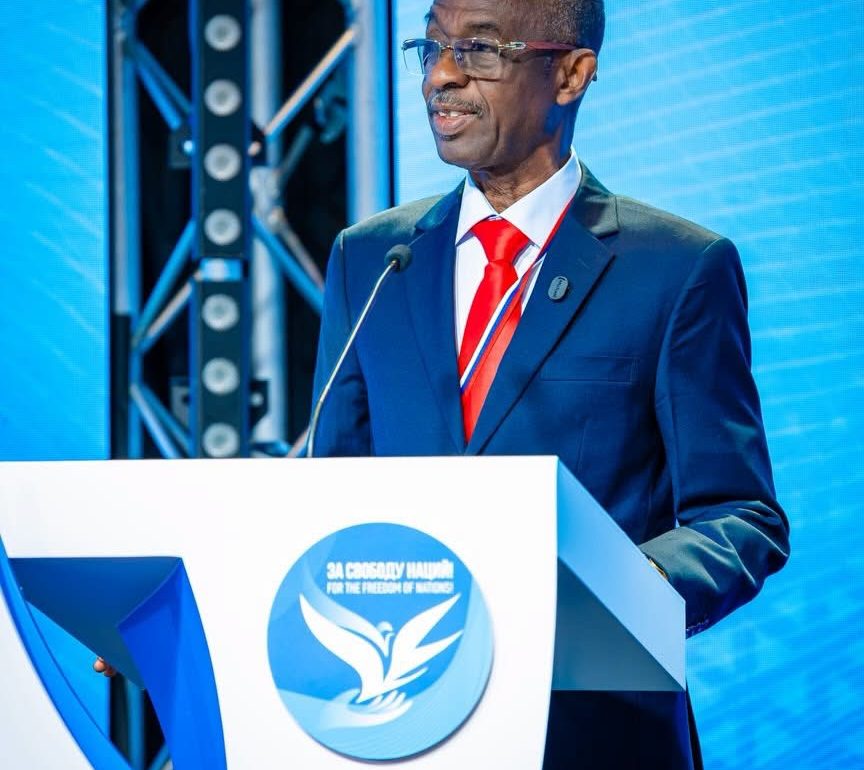
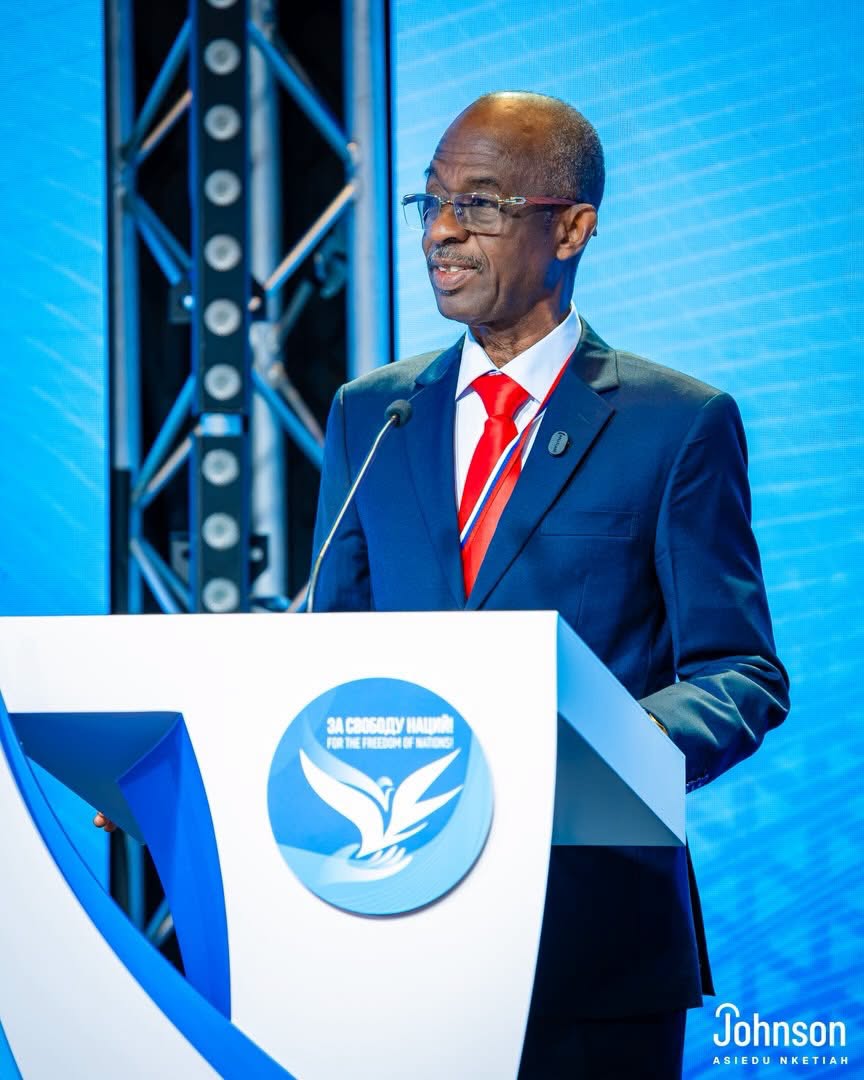
National Chairman of the ruling National Democratic Congress (NDC), Johnson Asiedu Nketiah has urged the Movement for Freedom of Nations to back the African Union’s work on reparations rather than set up institutions of its own.
He was speaking on reparative justice in Moscow on Monday, November 16, 2026.
“We would accomplish more by lending those institutions political support than by asking them to compete for attention and resources,” he said.
Mr Asiedu Nketiah said the Movement’s members could help by encouraging access to archives, supporting dialogue with museums and public authorities, and using their ties with governments and parliaments to support the AU’s experts and the CARICOM Reparations Commission.
He pointed to the return of Asante royal regalia to the Manhyia Palace Museum in Kumasi to show why the details of any remedy matter. Some items were fully restituted, he said, while others came from British museums on loan.
“A loan is not the same as a transfer of ownership,” he said.
Reparation claims, he added, must be backed by proof and a workable response.
“A credible claim must rest on evidence, and a credible response must be capable of implementation,” he said.
He also cautioned against loose use of the term. An ordinary development project, he said, does not become reparative justice “merely because it has been given a new description”. The link between the wrong and the remedy must be shown, and the outcome must be open to scrutiny.
The NDC chairman recalled that the AU named 2025 the Year of Justice for Africans and People of African Descent Through Reparations, and that its Decade of Justice and Reparations runs from 2026 to 2035.
An AU committee of experts and a reference group of legal experts are developing a Common African Position.
He praised President John Dramani Mahama, the AU Champion on Reparations, for Ghana’s role in securing UN General Assembly Resolution 80/250 on March 25, 2026, which received 123 votes in favour.
Drawing on his years in politics, Mr Asiedu Nketiah warned that declarations are easier to adopt than to act on.
“I have been involved in political organisation long enough to know how readily declarations are adopted and how difficult it can be to secure the action that follows,” he said.
He said any settlement should be negotiated carefully and run openly, with affected communities able to see what has been promised and whether it has been delivered.