

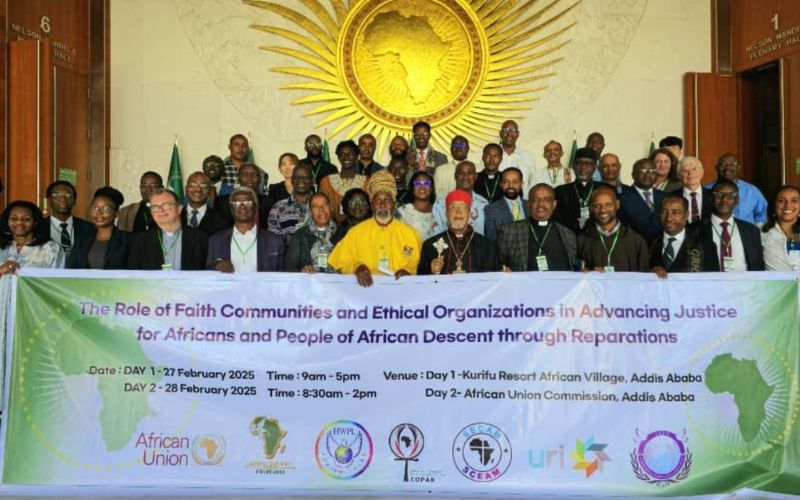
The workshop, which brought together AU officials, diplomats, religious leaders, scholars, human rights advocates, and policymakers to advance the AU’s reparations agenda, was organized under the theme “The Role of Faith Communities and Ethical Organizations in Advancing Justice for Africans and People of African Descent through Reparations.”
Other key partners in the organization of the workshop included the Interreligious Association for Peace and Development (IAPD-Africa), the United Religions Initiative (URI), and the Citizens and Diaspora Directorate (CIDO) of AUC.
In their “Addis Ababa declaration”, the delegates who also included cultural associations of African and international civil society resolved to center “Justice for Africans and People of African Descent through Reparations” within the African Peace Initiative.
They said that centering justice for African people will trigger “pursuit of a Civilizational Truce aimed at transforming a world marked by conflict, war, and dysfunction into societies characterized by dialogue, reconciliation, and reparations.”
They explained that the pursuit aligns with the principles of Ubuntu philosophy and the teaching of the Golden Rule on “treat others the way you want to be treated,” as well as the objectives of the AU’s Agenda 2063, which seeks to advance the vision of the AU, “An integrated, prosperous and peaceful Africa.”
The delegates emphasized individual and collective recognition of “the profound and lasting effects” of slavery, colonialism, racial discrimination, and neo-colonialism on Africans and people of African descent.
“We acknowledge how these injustices continue to inflict immense suffering, cultural disruption, economic exploitation, emotional trauma, and enduring discrimination on Africans and people of African descent throughout history,” they said.
The delegates further recognized “the concept of ecological debt as a critical component of reparations, acknowledging the severe environmental degradation caused by colonial exploitation, industrial pollution, and resource extraction.”
“We affirm that historical and ongoing environmental destruction, including deforestation, water contamination, soil depletion, and biodiversity loss, has disproportionately affected African communities, leading to food scarcity, health crises, and climate vulnerability,” they said.
In their declaration, the delegates expressed their support for the 2023 Accra Conference on Reparations and the recommendations directed to the member states of the AU on the inauguration of a Committee of Experts on Reparations.