

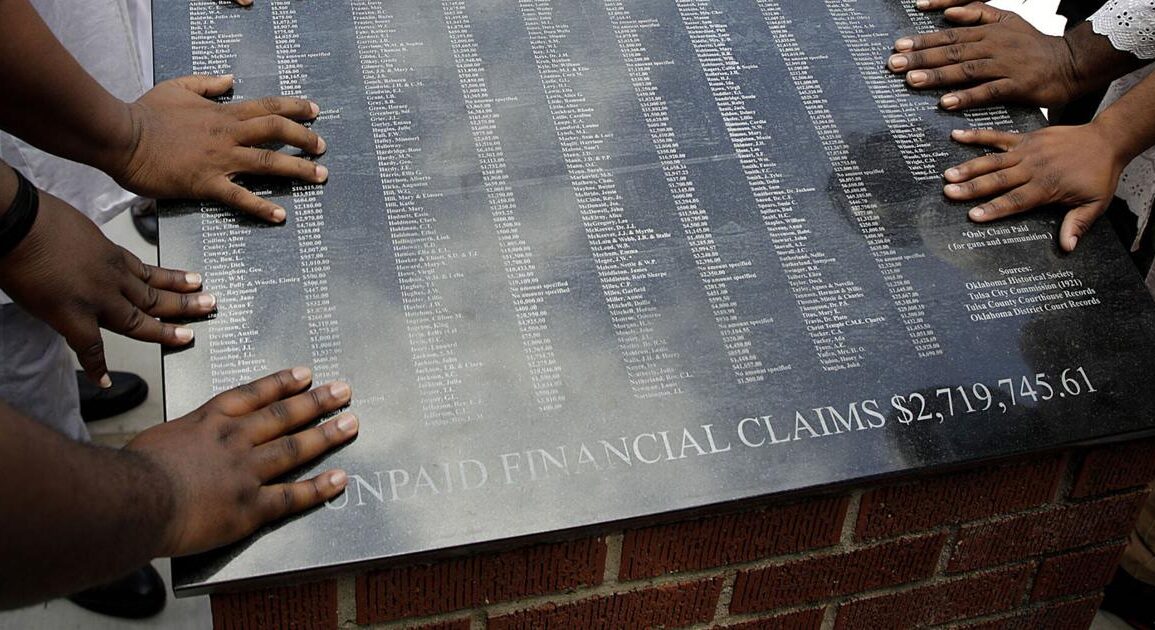

In announcing a proposal for the city of Tulsa to provide nearly $25 million in housing-related reparations to those harmed by the 1921 Tulsa Race Massacre, City Councilor Vanessa Hall-Harper reminded Tulsans on Monday that America has been down this road before.
“In 1988, President Ronald Reagan spoke these words to fellow Americans,” Hall-Harper said. “‘Members of Congress, distinguished guests, my fellow Americans, we gather here today to right a grave wrong. More than 40 years ago, shortly after the bombing of Pearl Harbor, 120,000 persons of Japanese ancestry living in the United States were forcibly removed from their homes and placed in makeshift internment camps. This action was taken without trial, without jury. It was based solely on race.’”
Breaking from Reagan’s words, she added: “Remember that statement: ‘It was based solely on race.’”
People are also reading…
Hall-Harper was reading from remarks Reagan made when signing into law a bill that provided restitution for the World War II internment of Japanese-Americans.
“There is absolutely nothing in this speech by the then-president of the United States that does not apply to … Black Tulsans living in Tulsa,” Hall-Harper said. “So you see, we must acknowledge that America does have a history of righting wrongs of Americans that goes beyond just an apology.”
Monday’s announcement, made during a press conference at City Hall, is the first major reparations proposal to come from the Beyond Apology Commission. The 13-member body was established by executive order last year by former Mayor G.T. Bynum to guide the city as it attempts to make good on its pledge to make tangible amends for the Tulsa Race Massacre.
The proposal calls for spending 82% of the $24.9 million total on housing benefits for eligible individuals. That would include 32% of the total amount for a home/land ownership program; 30% for a home preservation/improvement program; 12% for a home ownership readiness program; and 8% for a mortgage and property tax assistance initiative.
The remaining dollars — 18% of the overall amount — would be used to purchase property for north Tulsa development, to establish a $2 million reserve trust to pay for future benefit programs, and to cover administrative and management costs.
Beyond Apology Commission Chairwoman Kristi Williams said she and others on the commission felt a strong connection to the work they were charged with doing.
“Our commission is made up of mostly descendants of the 1921 Race Massacre,” Williams said. “So this is not just policy work for us. It is a deeply personal mission to honor our ancestors and secure a future where real, tangible repair takes place.”
Williams emphasized a point made in the commission’s recommendation — that the $24.9 million is only an initial request for funding.
“We call on city leadership, community partners and those who stand for justice to help us implement these recommendations and ensure that they are fully funded,” she said. “Comparative justice is an ongoing commitment, and we will not stop.”
To apply for benefits, individuals would have to be at least 18 years old, be of Black/African American ancestry, and fall into one of four tiers by which applications would be accepted and reviewed and benefits awarded.
Survivors — excluding perpetrators of the harm — would make up the top tier, followed by descendants, defenders and rebuilders; residents of Greenwood/north Tulsa from 1926 to 1971; and residents of Greenwood/north Tulsa from 1972 to 2020.
The Mayor’s Office, in conjunction with the Beyond Apology Commission, would be responsible for overseeing the Housing Reparations Program. The commission would determine who qualifies for benefits based on the criteria set out in the proposal.
Bynum established the Beyond Apology Commission after the creation of such a body was recommended in the Beyond Apology report.
That document summarized the results of a process called Beyond Apology, a series of community-led public meetings to engage and educate Tulsans about reparations and repair programs.
The Beyond Apology report listed eight priorities for possible repair and reparations: housing and home ownership, education, financial compensation, community and economic development, land, health and wellness, system change, and cultural identity.
Neither Bynum nor current Mayor Monroe Nichols has ever committed the city to paying reparations in the form of direct payments, but both have been open to establishing policies and programs to benefit those harmed during the Race Massacre, their descendants, and individuals who were affected by later discriminatory practices and policies in the city.
At the Beyond Apology Commission’s inaugural meeting in October, Bynum said housing equity had been chosen as the first priority to address because the city has a housing shortage and Tulsans approved $75 million for housing in the 2023 Improve Our Tulsa capital improvements package.
Greg Robinson, who facilitated the Beyond Apology process, said in an interview with the Tulsa World that the $24.9 million figure was based on best practices established in cities like Evanston, Illinois, that have implemented reparations programs.
“It certainly is not a number that is out of thin air,” Robinson said. “It’s a number that to us is rooted in a fair percentage of investment based on what we know, … for sure, is available.”
It is not clear whether or how Nichols plans to move forward with the commission’s request. Nichols did not attend Monday’s press conference but in a statement said he welcomed the commission’s work and indicated that he would speak about the matter soon.
“As mayor, I am grateful for the dedication and work of the Beyond Apology Commission,” Nichols said in the statement. “The Commissioners took on the nearly impossible task of aligning around a plan to appropriately address the harm caused by the 1921 Tulsa Race Massacre.
“I look forward to reviewing their recommendations and, in the coming weeks, share a framework that will serve as proof that Tulsa is united in healing the wounds left by the Massacre nearly 104 years ago.”
The massacre of May 31-June 1, 1921, left at least 37 people dead — and many people believe the figure to be much higher — and destroyed 35 blocks of the historic Greenwood District.
Greenwood was home to what was known as Black Wall Street, one of the most vibrant and prosperous Black communities in the country at the time.
One hundred years later, in June 2021, the Tulsa City Council and Bynum signed a nonbinding resolution acknowledging and apologizing for the Race Massacre.
The resolution also included a commitment to make “tangible amends” for the tragedy and a pledge to establish a community-led effort to recommend ways the city could make “significant progress toward restoring economic mobility, prosperity and generational wealth for the 1921 Race Massacre survivors, their descendants, and residents of North Tulsa.”
The Beyond Apology Commission’s recommendations are the manifestation of that pledge.